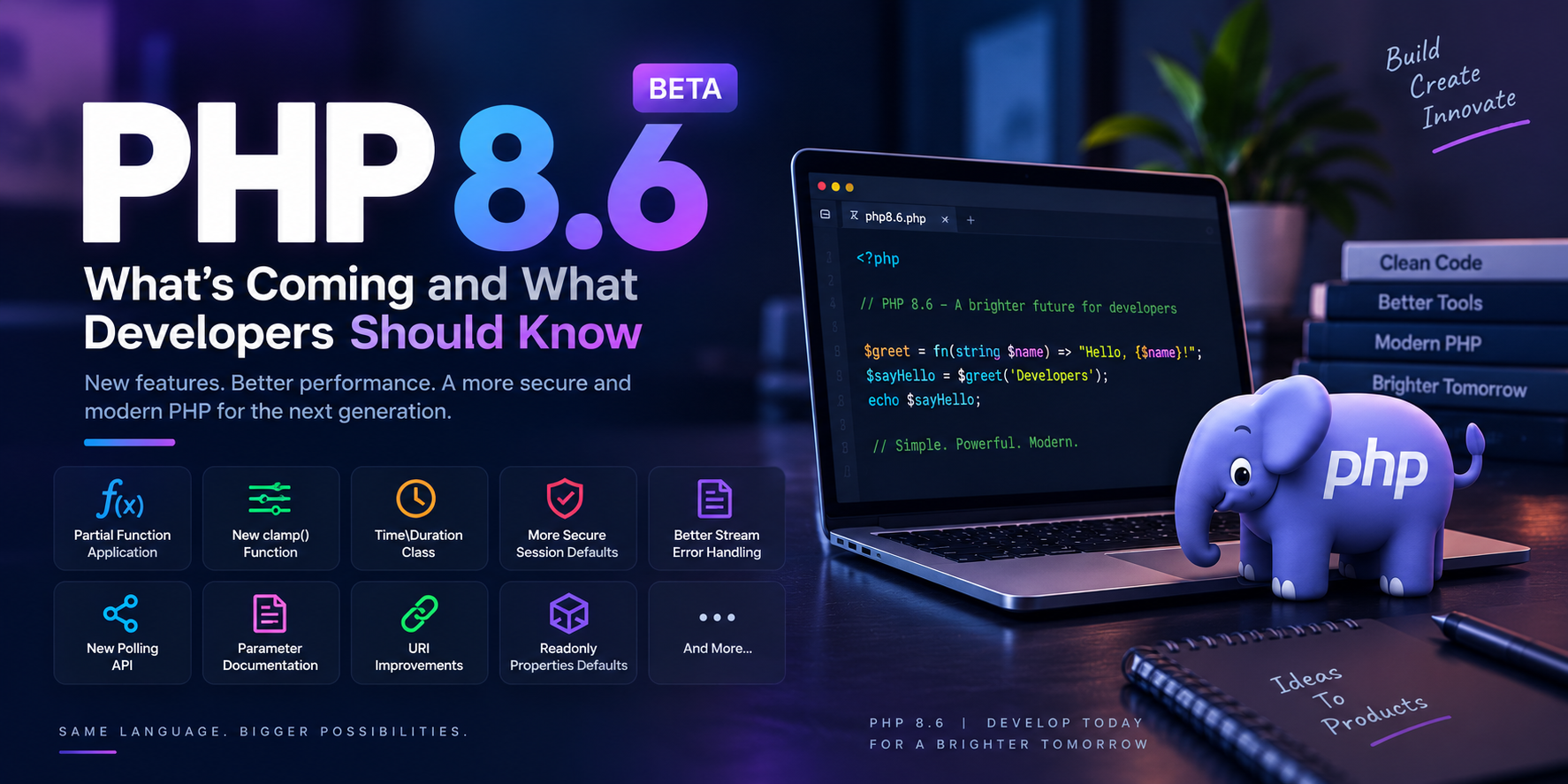
🚀 PHP 8.6: What's Coming and What Developers Should Know
PHP continues its yearly release cycle, and PHP 8.6 is now in beta.
The upcoming release is scheduled for November 19, 2026, with the feature freeze scheduled for September 22 and release candidates beginning later that week.
For PHP and Laravel developers, this is a good time to start exploring what's coming—not necessarily to move production applications to PHP 8.6 yet, but to understand the new language features and prepare your development environment.
Let's take a look at some of the most interesting changes. 👇
🧩 1. Partial Function Application
One of the more interesting additions in PHP 8.6 is partial function application.
It allows you to provide some arguments to a function now and receive a closure that accepts the remaining arguments later.
For example:
$makeSlug = str_replace(' ', '-', ?);

echo $makeSlug('Hello World');
// Hello-World
This can make certain functional programming patterns more concise and reduce the amount of wrapper code developers need to write.
The feature uses ? as a placeholder for an argument.
📏 2. A New clamp() Function
PHP 8.6 introduces a new clamp() function for restricting a value to a minimum and maximum range.
Instead of writing:
$value = min(max($value, 0), 100);
you can write:
$value = clamp($value, min: 0, max: 100);
For example:
clamp(50, min: 0, max: 100);
// 50

clamp(150, min: 0, max: 100);
// 100

clamp(-10, min: 0, max: 100);
// 0
This is a small feature, but it can make everyday application code easier to read. ✨
⏱️ 3. A New Duration Class
PHP 8.6 also introduces Time\Duration, a readonly class designed to represent lengths of time with nanosecond precision.
For example:
use Time\Duration;

$oneSecond = Duration::fromSeconds(1);

$halfSecond = $oneSecond->divideBy(2);

$total = $oneSecond->add($halfSecond);
Durations can be created from different units and can be compared or used in arithmetic operations.
This provides a more expressive way of working with time intervals than passing around loosely defined integers or floating-point values. ⏱️
🔒 4. More Secure Session Defaults
Security is another important area of PHP 8.6.
For new installations, several native PHP session defaults become more secure:
SettingPrevious DefaultPHP 8.6 Defaultsession.use_strict_mode01session.cookie_httponly01session.cookie_samesiteUnsetLax
These defaults provide stronger protection for applications that rely directly on PHP's native session handling.
Laravel applications generally manage session behavior through Laravel itself, so developers should still check their framework configuration rather than assuming these native defaults directly change their application.
🧪 5. Better Stream Error Handling
PHP streams have historically relied heavily on warnings for many types of errors.
PHP 8.6 introduces a more structured error-handling model with configurable stream error modes.
For example, applications can request exception-based handling:
$context = stream_context_create([
    'stream' => [
        'error_mode' => StreamErrorMode::Exception,
    ],
]);
This can make stream-related failures easier to handle consistently in applications and libraries. 🛡️
🌐 6. New Polling API
PHP 8.6 introduces an Io\Poll API for working with operating-system polling mechanisms.
It provides a unified interface for mechanisms such as:
- Linux
epoll - BSD/macOS
kqueue - Solaris event ports
- Windows polling
The primary motivation is improving low-level infrastructure and event-loop capabilities, but the API can also be useful to developers working on asynchronous runtimes and networking tools. ⚡
Most traditional Laravel applications won't need to interact with this directly, but it is an interesting development for the broader PHP ecosystem.
📝 7. Documentation Directly on Parameters
PHP 8.6 allows documentation comments to be placed directly on function parameters.
For example:
function search(
    /** Search terms */
    string $query,

    /** Maximum number of results */
    int $limit = 10,
): array {
    // ...
}
This allows IDEs and static-analysis tools to associate documentation directly with the parameter it describes. 💡
🔗 8. URI Improvements
PHP's URI functionality continues to evolve.
PHP 8.6 adds URI builder functionality, allowing developers to construct URIs more fluently:
$uri = new Uri\Rfc3986\UriBuilder()
    ->setScheme('https')
    ->setHost('example.com')
    ->setPath('/products')
    ->build();
This can be useful for applications that construct URLs dynamically, especially API clients and networking libraries. 🌐
📐 9. Readonly Properties Can Have Defaults
PHP 8.6 removes a restriction around readonly properties, allowing them to have default values.
For example:
final readonly class MigrationInfo
{
    public string $name = 'users';
}
Readonly behavior remains unchanged—the property still cannot be reassigned after initialization.
This can make certain immutable objects and interfaces easier to implement.
📊 10. PHP 8.5 Is Still the Production Choice for Now
An important point: PHP 8.6 is currently a beta release, not a final production release.
The PHP development team is continuing the release cycle, while PHP 8.5 remains a stable production version. PHP 8.5.10 was released on August 27, 2026 as a bug-fix release.
So if you're running a production Laravel or PHP application, this is the time to test and experiment, not blindly upgrade production servers.
🧪 How Developers Can Prepare for PHP 8.6
If you maintain PHP applications, you can start preparing now.
1. 🔍 Review Your Current PHP Version
Run:
php -v
Document which PHP versions your applications currently use.
2. 📦 Check Composer Dependencies
Review your:
composer.json
composer.lock
Third-party packages may have their own PHP version requirements.
3. 🧪 Create a Testing Environment
Don't experiment with a PHP beta release on production.
Create a separate development or staging environment specifically for PHP 8.6 testing.
4. ✅ Run Your Test Suite
Test important application functionality:
- Authentication
- Database queries
- APIs
- Queues
- Scheduled jobs
- File uploads
- Payments
- External integrations
5. 🔎 Watch for Deprecation Notices
Use the testing period to identify code that may need changes before upgrading.
This is especially important for older applications that have accumulated years of legacy code.
🧑💻 What About Laravel Developers?
Laravel developers should pay particular attention to framework and package compatibility before moving production applications to PHP 8.6.
Laravel 13 currently targets modern PHP versions and continues Laravel's focus on AI-native workflows, semantic/vector search, JSON resources, queues, caching, and security.
The PHP runtime and Laravel framework are separate upgrade decisions.
A project should therefore be tested as a complete stack:
PHP
 ↓
Laravel
 ↓
Composer packages
 ↓
Database
 ↓
Queue / Cache
 ↓
Web Server
 ↓
External Services
Upgrading one layer without testing the others can lead to unexpected compatibility problems.
📅 PHP 8.6 Release Timeline
The current PHP 8.6 schedule includes:
- ✅ Alpha releases — July 2026
- ✅ Beta releases — August–September 2026
- 📌 Feature freeze — September 22, 2026
- 🚀 Release candidates — beginning September 24, 2026
- 🎯 General availability — November 19, 2026
The schedule can change, so developers should check the official PHP release information before planning production upgrades.
🎯 Final Thoughts
PHP 8.6 isn't just about one headline feature.
The release brings a collection of improvements—from partial function application and clamp() to better error handling, secure session defaults, duration types, URI tooling, and a new polling API.
Some features will immediately improve everyday PHP development, while others are primarily useful for framework and infrastructure developers.
For now, the best approach is simple:
Learn it. Test it. Prepare for it. Don't rush production. 🚀
PHP 8.6 is scheduled for November 19, 2026, giving developers time to explore the new features and make sure their applications and dependencies are ready for the next generation of PHP. 💻✨

forum Discussion & Comments 0
rate_review Leave a Comment